
Call us now :08071930840
 Send Inquiry
 Send Inquiry
Brazilian Test Apparatus
Price 65000.0 INR/ Piece
Brazilian Test Apparatus Specification
- Features
- Good Quality
- Power Supply
- Manual
- Usage
- Hospital & Laboratory
- Frequency
- 50-60 Hertz (HZ)
- Voltage
- 110-215 Volt (v)
- Hardness
- Yes
Brazilian Test Apparatus Trade Information
- FOB Port
- DELHI
- Payment Terms
- Cash Advance (CA), Cash in Advance (CID)
- Supply Ability
- 10 Per Week
- Delivery Time
- 15 Days
- Sample Available
- No
- Sample Policy
- Free samples available with shipping and taxes paid by the buyer
- Main Export Market(s)
- Asia
- Main Domestic Market
- All India
About Brazilian Test Apparatus
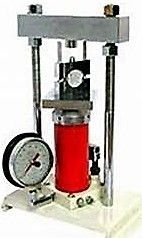
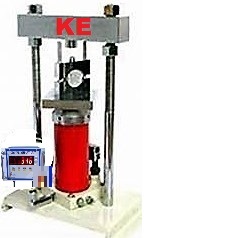
The Brazilian Test Apparatus, often simply referred to as the "Brazilian Test" or "Brazilian Disc Test," is a specialized piece of equipment used in materials science and civil engineering, particularly in geotechnical engineering, for the indirect determination of the tensile strength of brittle materials like rock and concrete.
Direct tensile testing of brittle materials is notoriously difficult due to their low tensile strength and the challenges in gripping specimens without inducing stress concentrations. The Brazilian test provides a practical and widely accepted alternative.
Purpose and Principle:
The core principle of the Brazilian test is to convert an applied compressive load into a tensile stress within a cylindrical or disc-shaped specimen. When a cylindrical specimen is loaded diametrically between two platens, compressive stresses are induced directly under the loading points. However, along the central vertical diameter (perpendicular to the loading direction), tensile stresses are developed. The specimen typically fails by splitting along this vertical diameter due to these induced tensile stresses. By measuring the maximum compressive load at failure, the indirect tensile strength of the material can be calculated using a specific formula derived from elastic theory.
Key Components of a Brazilian Test Apparatus:
A typical Brazilian Test Apparatus generally consists of:
-
Loading Frame (Compression Testing Machine): This is the fundamental component, providing the means to apply a controlled compressive load. It's essentially a robust compression testing machine, often equipped with:
- Sturdy Base and Crosshead: A strong framework to withstand the applied forces.
- Hydraulic Jack or Electromechanical Drive: For applying the load. Modern machines often use electromechanical drives for precise control of the loading rate.
- Load Measuring Device: This measures the applied force. It can be a:
- Proving Ring: (Older mechanical type) Measures deflection that correlates to load.
- Load Cell: (Modern electronic type) Directly measures load and provides digital readout.
- Displacement Measuring Device: Measures the deformation or penetration, though less critical for the final strength calculation in this specific test than in a CBR test.
-
Semi-Circular Loading Jaws (Bearing Blocks/Platens): These are specialized, curved steel fixtures designed to hold the cylindrical specimen. They make contact with the specimen over a small arc (typically about 10 degrees) along its diametral plane. These curved jaws ensure that the compressive load is applied along a line, thereby inducing the desired tensile stress field in the specimen's center. Different sizes of jaws are available for varying specimen diameters.
-
Specimen: A cylindrical or disc-shaped core specimen of the rock or concrete. Standard guidelines (e.g., ASTM D3967 for rock) specify the dimensions, particularly the diameter-to-thickness ratio (often between 0.2 and 0.75, with an optimal ratio of approximately 0.5).
-
Pressure Gauge/Digital Readout: Displays the applied load. Modern systems often have digital displays that integrate with data acquisition software.
-
Data Acquisition System (for advanced machines): Automated systems may include sensors to record load and displacement data, generate load-deformation curves, and even automatically calculate the tensile strength.
How it Works (General Procedure):
- Specimen Preparation: A cylindrical core sample of the material (e.g., rock or concrete) is prepared according to relevant standards, ensuring its dimensions and surface finish are within specified tolerances.
- Placement: The prepared cylindrical specimen is placed horizontally between the two semi-circular loading jaws of the apparatus.
- Load Application: A compressive load is gradually applied to the specimen by the loading frame at a constant rate. The load is applied diametrically across the specimen's circumference.
- Failure: As the load increases, tensile stresses are induced at the center of the specimen, perpendicular to the loading direction. When these tensile stresses exceed the material's tensile strength, the specimen typically splits along the loaded diameter.
- Maximum Load Recording: The maximum load applied at the point of failure is recorded.
- Calculation: The indirect tensile strength (t) is calculated using the formula: Where:
- P = Maximum applied compressive load at failure
- L = Length (thickness) of the specimen
- D = Diameter of the specimen
Applications:
The Brazilian test apparatus and method are widely used in:
- Geotechnical Engineering: Assessing the tensile strength of rock masses for tunnel design, slope stability analysis, and foundation design.
- Civil Engineering: Determining the tensile strength of concrete, which is crucial for the design of concrete structures, pavements, and dams.
- Mining Engineering: Evaluating rock strength for excavation and support system design.
- Material Characterization: For other brittle materials where direct tensile testing is impractical.
- Research and Development: Studying the fracture behavior of brittle materials under indirect tension.
The Brazilian test is valued for its relative simplicity, cost-effectiveness, and the ease of specimen preparation compared to direct tensile tests. However, it's important to note that the calculated tensile strength is an "indirect" value, and various factors like specimen geometry, loading conditions, and material anisotropy can influence the results.
Tell us about your requirement

Price:
Quantity
Select Unit
- 50
- 100
- 200
- 250
- 500
- 1000+
Additional detail
Mobile number
Email

More Products in Soil Testing Equipment Category
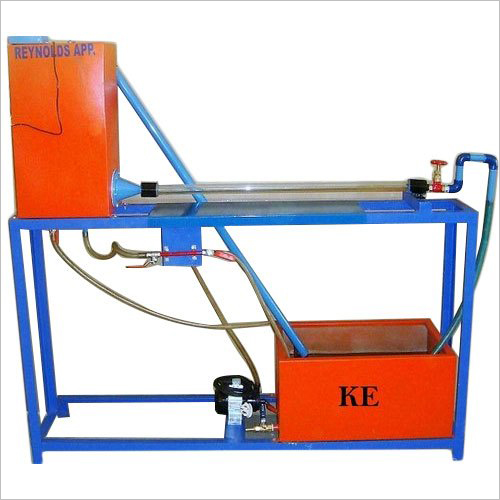
Reynolds Test Apparatus
Price 35000 INR / Piece
Minimum Order Quantity : 1 Piece
Features : Transparent glass tube, dye injection system, water tank
Hardness : Glass tube, Stainless Steel frame
Frequency : 50 Hz
Usage : Educational, Laboratory
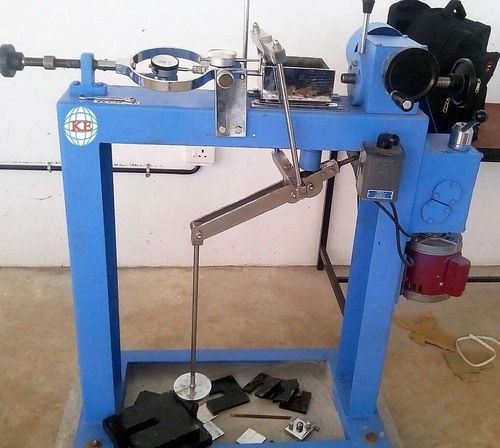
Direct Shear
Price 90600.0 INR / Piece
Minimum Order Quantity : 1 Number
Features : Good Quality
Hardness : Yes
Frequency : 5060 Hertz (HZ)
Usage : Laboratory
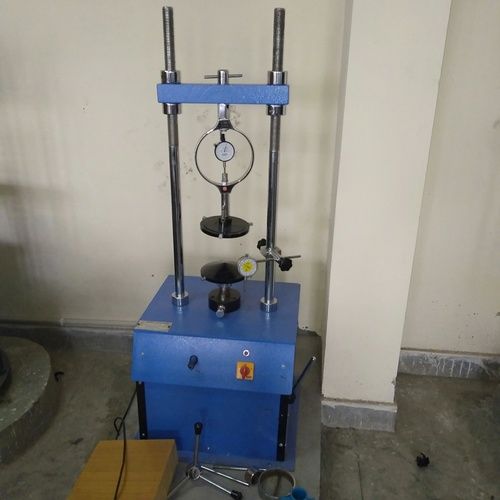
Unconfine Compression Testing Machine
Price 60500.0 INR / Set
Minimum Order Quantity : 1
Features : Good Quality
Hardness : Yes
Frequency : 5060 Hertz (HZ)
Usage : Industrial
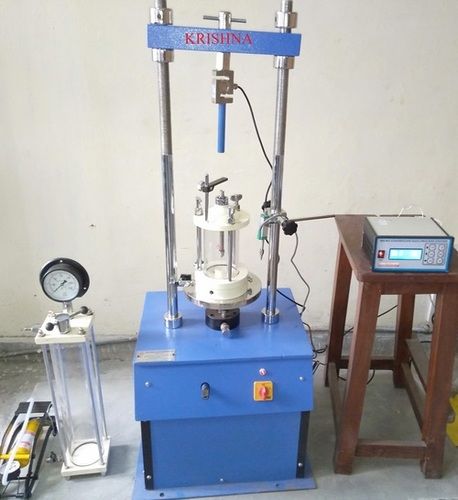
Triaxial Testing Machine
Price 125300.0 INR / Piece
Minimum Order Quantity : 1 Number
Features : Good Quality
Hardness : Yes
Frequency : 5060 Hertz (HZ)
Usage : Industrial

 Send Inquiry
Our Products
- Testing Equipment
- Testing Apparatus
- Soil Testing Equipment
- Universal Testing Machine
- Bulk Density Apparatus
- Core Cutting Machine
- Electrical Machine Lab Instrument
- Heat Transfer Laboratory Equipment
- Moisture Meter
- Compression Testing Machine Channel
- Educational Trainer
- Impact Testing Machine
- Digital Bomb Calorimeter
- Roll Crusher Machine
- Electric Control Panel

D-1, Block-B Gali No.25, Mangal Bazaar, Das Garden, Baprola Vihar, New Delhi - 110043, India

Mr R. K. Yadav
(Proprietor )
Mobile :08071930840
 Send Inquiry
 Send SMS
Developed and Managed by Infocom Network Private Limited.
